Interview with Paul Rogers, author of What to Believe When You Don't: A secular guide to life, the universe, and happiness
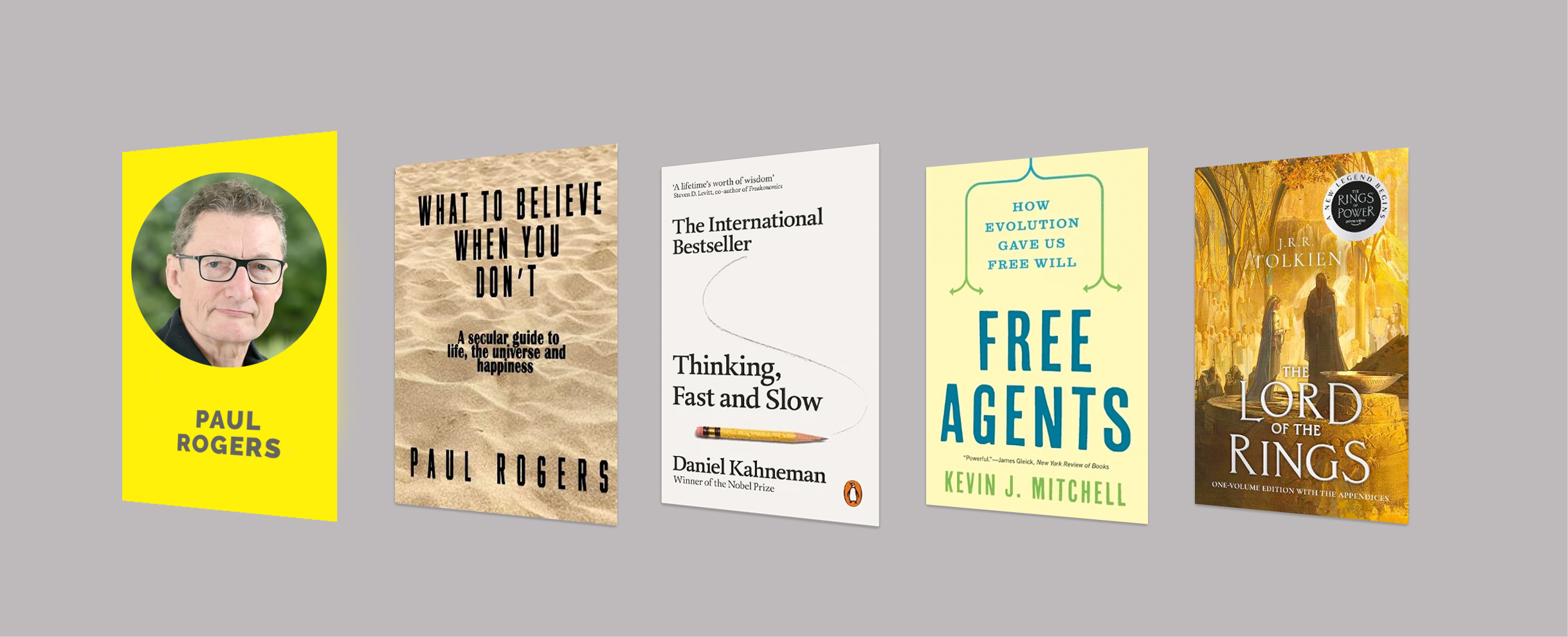
Paul Rogers, author of What to Believe When You Don't: A secular guide to life, the universe, and happiness recommends a great group of books! Before jumping into the interview, please check out Paul's book:
Description from Bookshop.org: (All links earn commission from purchases)
What to Believe When You Don't: A secular guide to life, the universe, and happiness
'What to Believe When You Don't' invites you to explore the vibrant tapestry of human existence without the prop of supernatural belief. You'll explore a wide range of topics and see how all are governed by beautifully logical natural explanations, no divine interventions needed!
You are guided throughout by an engaging, reader-friendly author who wears his learning lightly, and draws on crisp expert insights, hard data, and captivating anecdotes to make complex issues simple.
Above all, 'What to Believe When You Don't' gives the reader practical ideas to help you make your own decisions about how to live and be happy.
Buy On:
Bookshop.org UK
Waterstones
Q. Do you have a favourite smart thinking book (and why that book)?
Thinking, Fast and Slow by Daniel Kahneman. Description from Bookshop.org: (All links earn commission from purchases)
Kahneman combines mind-expanding content with a writing style which is crisp and clear. He shows how we are susceptible to an extended series of “mind traps”, so that what we may experience as rational decisions are in fact often the product of unconscious instinct. The book is intellectually engaging from start to finish, as well as being a pleasure to read.
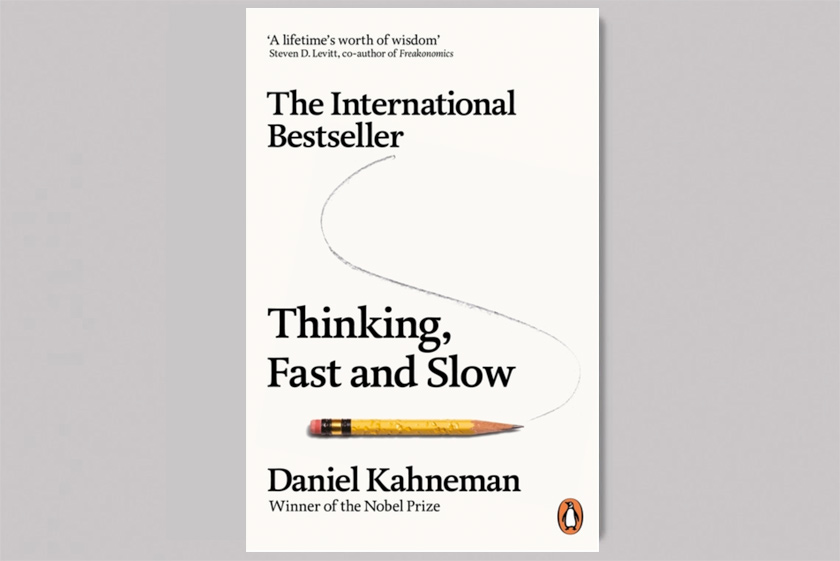
Thinking, Fast and Slow
Why do we make the decisions we do? Nobel Prize winner Daniel Kahneman revolutionised our understanding of human behaviour with Thinking, Fast and Slow. Distilling his life's work, Kahneman showed that there are two ways we make choices: fast, intuitive thinking, and slow, rational thinking. His book reveals how our minds are tripped up by error, bias and prejudice (even when we think we are being logical) and gives practical techniques that enable us all to improve our decision-making. This profound exploration of the marvels and limitations of the human mind has had a lasting impact on how we see ourselves.
Buy On:
Bookshop.org UK
Bookshop.org US
Waterstones
Q. What's the most recent smart thinking book you've read (and how would you rate it)?
Free Agents: How Evolution Gave Us Free Will by Kevin J. Mitchell. Description from Bookshop.org: (All links earn commission from purchases)
I’d rate this a 5 out of 5. The question of whether our subjective experience of agency is real or illusory turns out to be the focus of ongoing and sometimes heated debate. Mitchell looks at both sides of the argument in a calm and authoritative way, making clear what needs to be true to underpin a belief that agency is real, and why he feels this is the correct answer.

Free Agents: How Evolution Gave Us Free Will
Scientists are learning more and more about how brain activity controls behavior and how neural circuits weigh alternatives and initiate actions. As we probe ever deeper into the mechanics of decision making, many conclude that agency—or free will—is an illusion. In Free Agents, leading neuroscientist Kevin Mitchell presents a wealth of evidence to the contrary, arguing that we are not mere machines responding to physical forces but agents acting with purpose.
Traversing billions of years of evolution, Mitchell tells the remarkable story of how living beings capable of choice arose from lifeless matter. He explains how the emergence of nervous systems provided a means to learn about the world, granting sentient animals the capacity to model, predict, and simulate. Mitchell reveals how these faculties reached their peak in humans with our abilities to imagine and to be introspective, to reason in the moment, and to shape our possible futures through the exercise of our individual agency. Mitchell’s argument has important implications—for how we understand decision making, for how our individual agency can be enhanced or infringed, for how we think about collective agency in the face of global crises, and for how we consider the limitations and future of artificial intelligence.
An astonishing journey of discovery, Free Agents offers a new framework for understanding how, across a billion years of Earth history, life evolved the power to choose, and why it matters.
Buy On:
Bookshop.org UK
Bookshop.org US
Waterstones
Q. Do you have a favourite childhood book?
The Lord of the Rings by J.R.R. Tolkien. Description from Bookshop.org: (All links earn commission from purchases)
Not very original, maybe, but nonetheless my favourite childhood book by a wide margin. I must have read it at least 15 times by the time I turned 15 myself. I ended up reading English as my degree and as it happens I was asked this very question at my entrance interview. Of course I gave this answer, which produced a splutter from my interviewer, who happened to be the leader of the Old & Medieval English department. He expressed the view that Tolkien, who was for many years Professor of Old English at Oxford, should have focused on his academic research rather than wasting his time writing fantasy fiction. I begged respectfully to differ then, and I still do now.

The Lord of the Rings
Sauron, the Dark Lord, has gathered to him all the Rings of Power – the means by which he intends to rule Middle-earth. All he lacks in his plans for dominion is the One Ring – the ring that rules them all – which has fallen into the hands of the hobbit, Bilbo Baggins.
In a sleepy village in the Shire, young Frodo Baggins finds himself faced with an immense task, as the Ring is entrusted to his care. He must leave his home and make a perilous journey across the realms of Middle-earth to the Crack of Doom, deep inside the territories of the Dark Lord. There he must destroy the Ring forever and foil the Dark Lord in his evil purpose.
Buy On:
Bookshop.org UK
Bookshop.org US
Waterstones
Q. Do you prefer reading on paper, Kindle or listening to an audiobook?
Definitely paper. There is something about the physical sensation of the paper, and of turning the pages. I also like to be able to flip backwards, or occasionally forwards, to remind myself of relevant details. Finally, if I like a book I have read, I like to add it to my physical library, partly so that I can come back to it again later if I want to, and partly because I am fortunate to have a study which has shelves stacked with what I consider to be great books, and I like to spend time in that atmosphere.
Having said this, I am not against Kindle. That can be a good experience too. It is just that I tend to use it only when I am travelling, and for books I expect not to want to add to my physical library.
I have never tried an audiobook.
Q. Do you have a favourite bookshop (and why that shop)?
Waterstones Trafalgar Square
Waterstones in Trafalgar Square, although almost any Waterstones would do. It’s great that in this day and age there is still a haven in which you feel books, and writers, are celebrated as they deserve to be. I try to ration my visits, though, because whenever I go in I end up buying an armful of books which are more than I can possibly read in any sensible timeframe.
Many thanks to Paul for recommending a great group of books! Please don't forget to check out What to Believe When You Don't: A secular guide to life, the universe, and happiness.
Daryl
Image Copyrights: (What to Believe When You Don't: A secular guide to life, the universe, and happiness), Penguin Books Ltd (Thinking, Fast and Slow), Princeton University Press (Free Agents: How Evolution Gave Us Free Will), HarperCollins Publishers (The Lord of the Rings).
< Home